
A few months ago, I found myself staring at two AI detection reports for the same piece of content.
The first tool said the article was almost entirely human-written.
The second tool was convinced it was AI-generated.
Same article. Same words. Completely different verdict.
At first, I thought I had done something wrong. Maybe a few paragraphs needed to be rewritten, the structure was too clean, or the sentences sounded a little too predictable. I kept looking for something that would explain the result.
Then I tried another detector.
Different result again.
That’s when I realized the problem wasn’t the article.
The problem was that everyone was treating AI detectors as if they were fact checkers.
They’re not.
Why AI Detectors Disagree
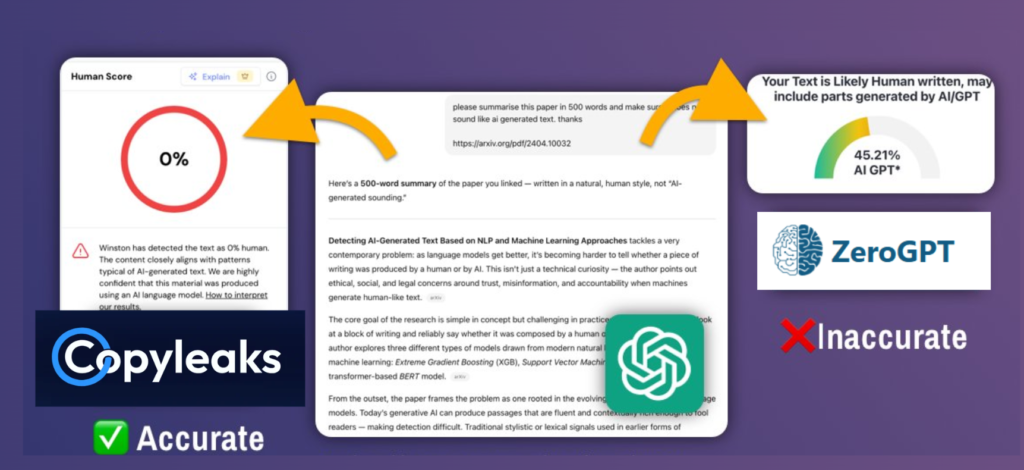
A plagiarism checker can usually point to a source and show where content was copied from. AI detectors don’t work that way. They analyze patterns and make predictions. Different tools use different models, different datasets and different thresholds.
That’s why one detector might label an article as 100% human while another claims it is 100% AI.
For freelance writers, this creates a frustrating situation.
A client says they want human-written content. Fair enough. Most professional writers want to deliver exactly that.
The challenge begins when “human-written” gets reduced to a score generated by software.
When Good Writing Becomes a Problem
Suddenly, the quality of the research doesn’t matter as much.
The originality of the ideas doesn’t matter as much.
The writer’s expertise doesn’t matter as much.
The only thing that seems to matter is whether a detector approves of the article.
The irony is that many of the qualities clients value in professional writing can trigger AI detectors.
Clear structure.
Consistent grammar.
Strong readability.
Logical flow.
These are skills that experienced writers spend years developing. Yet those same qualities are often interpreted by detectors as signs of AI-generated text.
Meanwhile, genuinely AI-generated content sometimes passes detection tools with ease.
That’s because detectors are not measuring authorship. They’re measuring patterns.
And patterns can be misleading.
The Cost to Freelance Writers
I’ve seen writers spend hours rewriting perfectly good content simply to satisfy a detector score.
Sentences get rearranged.
Words get swapped.
Paragraphs become awkward.
The article becomes worse, not better.
All because software made a prediction.
For freelancers, this isn’t simply about a score on a screen.
A rejected article can mean lost income.
A failed project can mean losing a long-term client.
Months of relationship building can disappear because two detection tools produced different results.
That’s the reality many writers face.
What Clients Should Focus On Instead
What clients really want isn’t a low AI score.
Most clients aren’t searching for a perfect AI score. They’re looking for original work, accurate information and content that demonstrates real understanding of the topic. They want to know that the writer has put genuine thought and effort into the piece and can communicate complex ideas in a clear way.
Those things cannot be measured by a percentage.
Trust has always been part of the relationship between a client and a writer. Long before AI existed, clients hired writers because they trusted their ability to research, think and communicate.
That hasn’t changed.
What has changed is the temptation to replace judgment with software.
A Score Is Not Proof
AI detectors have their place. They can be useful signals. They can raise questions worth investigating.
But they should never be treated as final proof.
A percentage score cannot tell you who wrote an article.
A percentage score cannot measure expertise.
And a percentage score cannot replace the relationship between a client and a writer.
The next time an AI detector declares a piece of content 100% human or 100% AI, it may be worth asking a simple question:
How much trust should we place in a tool that cannot agree with its competitors?